

As I continued to work with hundreds of websites, from local businesses to large-scale e-commerce, I noticed a trend that I have seen throughout my professional career – broken website foundations will not allow even the best content and backlinks to rank. This is where the need for a technical SEO audit becomes apparent. Technical SEO audit services are the diagnosis of any serious SEO strategy and are integral rather than optional.
This guide incorporates my years of experience and knowledge with technical SEO audits and provides a look into the considerations and tools that professionals utilize, as well as the common pitfalls that are associated with technical SEO audit services.
What is a Technical SEO Audit Service?
Technical SEO audit services are processes where professionals diagnose website framework elements and identify the issues that make crawlers unable to scan, index, or rank pages. Some of the website framework elements include crawlability, site structure, and page speed.
Content and link building audits may have their focuses, but a technical audit focuses on the interactions between a website and the search engine crawlers. Similar to a website’s visual elements, communication with crawlers should not have any issues; otherwise, it can be detrimental to a website’s traffic and rankings. Think of a technical SEO audit as a health check for a website.
Why Technical SEO Audits Matter (And Why Experience Counts)
I used to think technical SEO revolved around a couple of basic tasks like checking for broken links and sending off sitemaps. Based on practical experience auditing websites. That it has become a lot more thorough. After all, it is important to keep in mind how Google evolves. Some things that we should now consider include the following:
This is essentially Google’s E-E-A-T framework, at a more technical level. A site that is poorly designed, even if it contains valuable content, will give off a confusing impression of being trustworthy and authoritative. For this reason, in the upcoming years, seo technical audit services will be essential for businesses to achieve their goals of organic growth.
Key Elements in Technical SEO Audit Services
Drawing from years of experience performing audits for clients with everything from small personal blogs to large e-commerce sites with millions of product pages, the following are the primary pillars every reputable technical seo audit service must include:
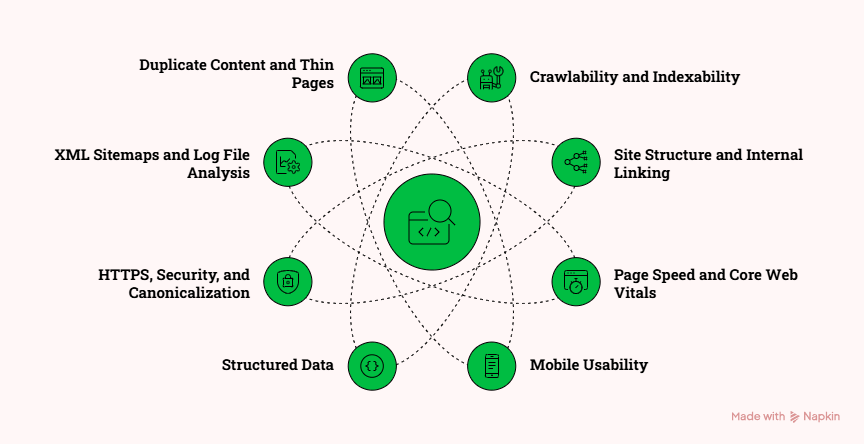
Crawlability and Indexability
This section is typically the logical starting point for most audits. Using tools such as Screaming Frog, Sitebulb, or even Google Search Console, auditors typically look for:
- Errors in the robots.txt configuration
- Blocked resources (CSS/JS) that hinder proper rendering
- Orphan pages with no internal linking
- Inadvertently imposed noindex tags on important pages
I have seen sites lose 40% of their organic traffic because the developer added a “Disallow: /” robots.txt line after site migration. This is an example of an oversight that a thorough technical audit will catch.
Site Structure and Internal Linking
A logical site structure aids users and search engines in understanding hierarchy and relationships between various topics and site content. Flat architecture, broken internal links, and pages that are deeply buried (5+ clicks from the homepage) are common findings in technical seo audits.
Page Speed and Core Web Vitals
Ever since Google made Core Web Vitals a ranking factor, this has quickly become one of the most in-demand components of a technical seo audit service. Typically, auditors check the:
- Largest Contentful Paint (LCP)
- Cumulative Layout Shift (CLS)
- Interaction to Next Paint (INP)
Some of the issues that I have most commonly found are unoptimized images, JavaScript that blocks rendering, and large/bloated third-party scripts (tracking pixels, chat widgets, ad scripts).
Mobile Usability
It has been the norm since 2019 to employ mobile-first indexing. Now, during a technical audit, it becomes imperative to check whether the site’s mobile version is identical to the desktop version in terms of its content, structured data, and metadata.
Structured Data (Schema Markup)
While structured data is intended to yield better search results by giving search engines the data for context (e.g., product prices and reviews, search results for Q&A, and many others), poor or no structured data is one of the most common issues found in DIY audits, and is almost always the first item a professional seo technical audit services consultant will check.
HTTPS, Security, and Canonicalization
Multiple URLs effectively serve the same content due to duplicate content from unsecured vs. secured sites, www vs. non-www, and missing canonical tags, and that can shift spell casting for page ranks. Resolving the above issues effectively constrains domain authority to the one verified, correct page.
XML Sitemaps and Log File Analysis
Checking whether the sitemaps show all the live, indexable pages, and cross-checking that with server log files, tells how actual searching functions are being performed by search engines, contrary to popular belief.
Duplicate Content and Thin Pages
On eCommerce sites, especially those with filtered navigation, thin and duplicate content can quietly reduce search rankings and exhaust crawl budget.
Tools I Use Based on Practical Experience Auditing Websites in the Industry
Every provider of SEO audit services has their own set of tools. I have my own set of tools:
- Screaming Frog SEO Spider (for crawling and auditing)
- Google Search Console (fetch and analyze index and performance stats)
- Google PageSpeed Insights / Lighthouse (Core Web Vitals)
- Ahrefs or Semrush (audit site health and backlinks)
- Log file analyzers (Botify, JetOctopus, or custom scripts)
Every SEO tool has its limits, and a real expert will look at the data from as many tools as they can to figure out what the issue is and not just that there is an issue.
Choosing a Technical SEO Audit Service
In my 12 years of service assisting clients in selecting a vendor, I can say with confidence that these are the major components that separate a legitimate provider from an illegitimate one that worked with a template:
They will show an improvement in crawl stats, indexing, and ranking, and will be able to show these stats before and after the fixes.
They will show an improvement in crawl stats, indexing, and ranking and will be able to show these stats before and after the fixes, due to their familiarity with Google’s Core Web Vitals and the frequent updates to Google’s algorithms.
- Common Mistakes I’ve Seen Businesses Make
- Considering a technical audit a one-time task
- Only fixing broken links, but leaving crawl budget and structure issues
- Hiring services that produce automated reports with no human insights
- Ignoring technical issues that are mobile-centric
What are the Most Common Questions
- What does a technical SEO audit service include?
Typical Technical SEO audit services checks the crawlability and indexability, the architecture and internal linking, Core Web Vitals and speed and usability checks, technical checks (TLS/HTTPS and security), validation of structured data, and checks for canonicalization, sitemaps, and thin and duplicate content. A good service will rank these findings in order of business impact.
- How is a technical SEO audit different from a general SEO audit?
General Technical SEO audit services address issues that stem from content, keywords, and backlinking. A technical seo audit looks at the crawlability, rendering, and indexability of the site from the search engine’s perspective and examines the ease with which a search engine can access, traverse, and analyze the site. Both are important, but issues encountered in the technical audit most often limit the impact of high-quality content and backlinks, which is why a technical seo audit needs to be one of the first tasks.
- How often should I do a technical SEO audit?
A full Technical SEO audit services typically only needs to be done every 6 to 12 months. These audits can be monitored in the meantime. There are exceptions to this rule. If you recently migrated your site, changed your CMS, redesigned your URL Structure, or experienced a drop in traffic, an audit should be done outside the designated timeframe.
- Is it possible to do a technical SEO audit on my own, or do I need to hire a service?
Many parts of the Technical SEO audit services can be done personally. These include using the Google Search Console to identify pages that are not indexed or checking your website’s load time using PageSpeed Insights. Problems that are harder to identify, such as crawl budget problems, log file problems, or problems with SEO and JavaScript, are going to be harder to identify with tools that are available for personal use. These problems, if not diagnosed properly, will negatively impact search rankings and cause wasted development time.
- How long does a technical SEO audit take?
The size of a website directly correlates to the amount of time it takes to conduct a technical SEO audit. A thorough audit of a smaller website may take a few days, while a larger website may take a few weeks. Certain factors, such as an audit of a crawl budget, take an extensive amount of time because they require numerous sets of data that are collected over time.
- What are the benefits of resolving technical SEO concerns?
Although there is some variance, relevant benefits that are most often observed post SEO audit include more efficient crawling, faster updating of indexed content, better Core Web Vitals, and a more noticeable ranking improvement after weeks or even months. When it comes to technical SEO, the results are never immediate, but the work addresses challenges and changes that are negatively impacting the potential growth of the site.
- Is the technical SEO audit a one-and-done task?
Definitely not. New pages are constantly being added or removed, plugins are constantly being modified and improved, and Google continues to modify and improve its algorithms. Regular technical SEO audits are one of the key differentiators I’ve observed between websites that experience continued growth and websites that lose growth after the first improvement.
Final Words
While I have developed a lot of experience through the years, one of the most important lessons I have learned is how important technical SEO is for the design and growth of a website. Backlinks and content will only be as useful as the structure of the technical SEO.
Engaging in professional technical SEO audit services is focused more on the potential growth of the site than on addressing every minor warning in a crawl report. When considering potential technical SEO audit services, focus on the experience, accurate and honest reporting, and a process that integrates technical expertise and a clear understanding of your business rather than a generic automated process.